AI vs Traditional Anime Artists – Which One Is Better in 2026?
The anime industry has always been driven by creativity, imagination, and artistic skill. For decades, traditional anime artists dominated the field with hand-drawn illustrations, frame-by-frame animation, and years of hard-earned expertise. However, in 2026, Artificial Intelligence has entered the anime world at full speed, raising a critical question:
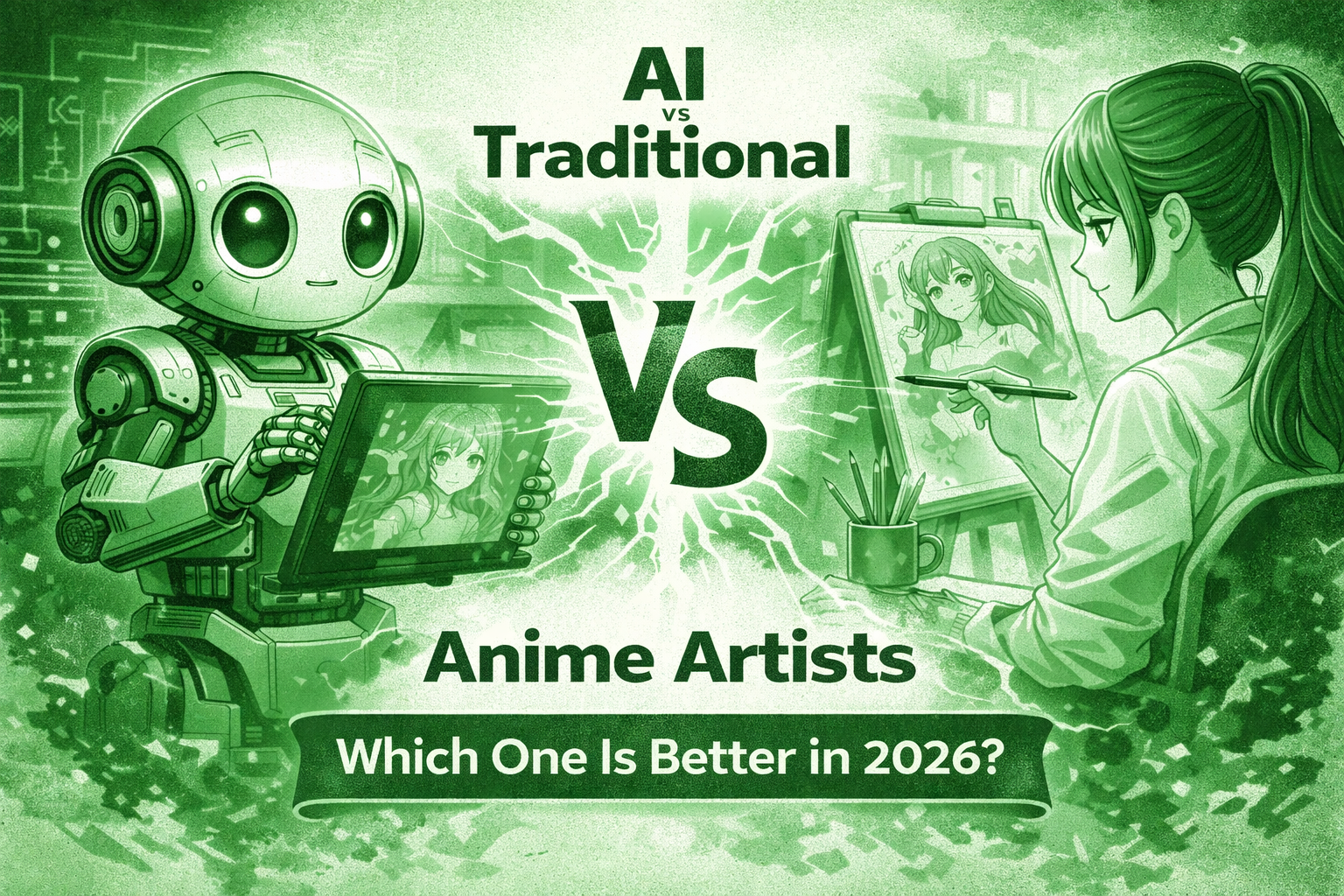
AI vs Traditional Anime Artists – which one is better in 2026?
This debate is no longer theoretical. AI-generated anime art, animations, and videos are already being used by YouTubers, game developers, studios, and independent creators. In this article, we’ll compare AI anime creators and traditional anime artists in terms of quality, cost, speed, creativity, and future potential.
Understanding AI Anime Artists
AI anime artists are not humans. They are AI-powered tools trained on massive datasets of anime-style artwork. These tools generate anime art based on text prompts, reference images, or style inputs.
What AI Anime Tools Can Do:
- Generate anime characters instantly
- Create backgrounds and environments
- Produce anime-style videos
- Animate characters
- Maintain consistent art styles
AI does not replace imagination—it executes ideas at machine speed.
Understanding Traditional Anime Artists
Traditional anime artists are skilled professionals who create anime art manually using drawing tablets or pen and paper. Their work involves years of training in anatomy, composition, color theory, and storytelling.
What Traditional Artists Excel At:
- Emotional depth
- Original storytelling
- Handcrafted art styles
- Deep artistic expression
Traditional anime art is rooted in human experience and intuition.
Speed: AI vs Traditional Anime Artists
AI Anime Artists
AI tools can generate:
- Anime characters in seconds
- Full scenes in minutes
- Multiple variations instantly
Traditional Anime Artists
Manual creation takes:
- Hours for a single illustration
- Days or weeks for animations
Winner (Speed): AI Anime Artists
Speed is one of AI’s strongest advantages.
Cost Comparison: AI vs Traditional Artists
AI Anime Creation
- Monthly subscription cost
- No salary or hourly fees
- Scales infinitely
Traditional Anime Artists
- High hourly or project-based fees
- Studio costs
- Limited scalability
For beginners and startups, AI is significantly more affordable.
Winner (Cost Efficiency): AI Anime Artists
Quality: Who Creates Better Anime Art?
This is where the debate becomes interesting.
AI Anime Art Quality
- Extremely high visual quality
- Cinematic lighting
- Consistent styles
- Rapid improvement every year
Traditional Anime Art Quality
- Unique personal touch
- Emotional storytelling
- Original line work
In 2026, AI anime art is visually impressive, but traditional artists still dominate when it comes to deep emotional storytelling.
Winner (Visual Quality): Tie
Winner (Emotional Depth): Traditional Artists
Creativity & Originality
AI Creativity
AI generates art based on:
- Existing data
- Learned patterns
It cannot truly “imagine” like a human, but it can remix ideas brilliantly.
Human Creativity
Traditional artists:
- Invent original styles
- Create new genres
- Push artistic boundaries
Winner (Creativity): Traditional Anime Artists
Consistency & Scalability
AI Anime Artists
- Perfect style consistency
- Easy character reuse
- Unlimited output
Traditional Anime Artists
- Fatigue and time limits
- Style may evolve unintentionally
Winner (Scalability & Consistency): AI Anime Artists
Learning Curve: Which Is Easier to Start?
AI Anime Creation
- Beginner-friendly
- No drawing skills needed
- Prompt learning is enough
Traditional Anime Art
- Years of practice
- Technical skills required
- Steep learning curve
Winner (Beginner-Friendly): AI Anime Artists
Monetization Opportunities in 2026
AI Anime Monetization
- YouTube anime videos
- Shorts & Reels
- Freelancing
- Digital art sales
- AI game assets
Traditional Artist Monetization
- Studio work
- Commissions
- Manga creation
AI opens more income paths for beginners and solo creators.
Winner (Monetization Flexibility): AI Anime Artists
Job Security & Industry Acceptance
Traditional Anime Artists
- Still essential in studios
- Strong artistic demand
- Core storytelling roles
AI Anime Tools
- Used as production assistants
- Speed up workflows
- Reduce repetitive work
Studios now prefer hybrid creators who understand both.
Ethical & Copyright Concerns
AI Anime Art
- Licensing depends on tools
- Dataset transparency issues
- Requires careful commercial usage
Traditional Art
- Clear ownership
- Fewer legal concerns
Winner (Ethics & Ownership): Traditional Anime Artists
AI + Human Collaboration: The Real Winner
The biggest trend in 2026 is not AI vs humans—it’s AI + humans.
Many professionals now:
- Use AI for drafts
- Refine art manually
- Speed up production
- Focus on storytelling
This hybrid approach produces the best results.
Which One Is Better in 2026?
Let’s summarize:
| Category | Winner |
|---|---|
| Speed | AI |
| Cost | AI |
| Quality | Tie |
| Creativity | Traditional |
| Scalability | AI |
| Beginner-Friendly | AI |
| Emotional Depth | Traditional |
Final Answer:
- For beginners, content creators, and solo entrepreneurs → AI Anime Artists are better
- For studios, storytelling, and artistic mastery → Traditional Anime Artists remain superior
- For the future → Hybrid creators will dominate
Future Outlook: 2026 and Beyond
In the coming years:
- AI will handle production
- Humans will lead creativity
- Anime content will grow faster than ever
Artists who adapt will thrive. Those who ignore AI may struggle.
Final Thoughts
AI is not the enemy of traditional anime artists. It is a powerful tool that reshapes how anime is created, consumed, and monetized. In 2026, the real advantage belongs to creators who embrace both technology and artistry.